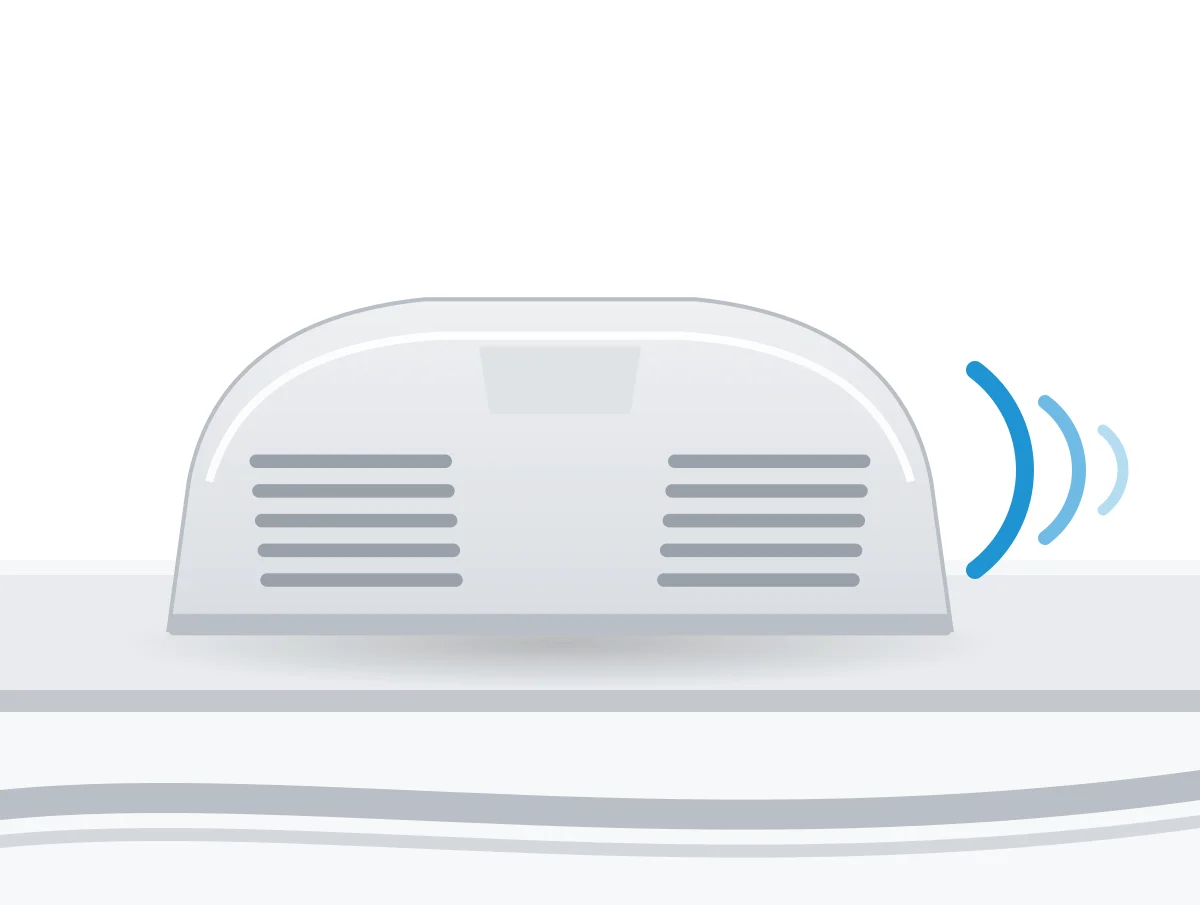
On low fan, RecPro's rooftop units are rated 3.3 to 9 dB quieter indoors than on high. No other change on this page is as cheap, and it costs nothing but a little cooling. The rest is hardware that a rooftop unit loosens over the road: the shroud screws, the four bolts that clamp it to the roof, and the gasket between them.
Dometic, Coleman-Mach, Furrion and Houghton cover both halves in their manuals and support pages. They also cover the other question owners ask, which is what an RV AC means by a loud noise it did not make last season, and which sounds mean switch off and call for service.
The documents are Dometic's guide for the Brisk Air, Brisk II, Penguin II, FreshJet 3 and FreshJet 5 with its air distribution box, and its AirCommand AC-1361 and AC-1511 manual; Coleman-Mach's 48000 Series owner's manual, Mach 10 48V instructions and 476XX export manual; Lippert's Furrion training hand-out and Furrion's February 2026 support article; and Houghton's Belaire manual, which RecPro posts for its RP-AC3500 and RP-AC3800. No current Atwood-branded rooftop manual turned up on a maker site; the AC-1361 and AC-1511 are documented by Dometic under the AirCommand name. Decibel figures come from the RV air conditioner guide.
Built-in noise and the part you can change
A compressor, a condenser fan and a blower share one box, bolted to a thin roof a few feet above the bed, with only the ceiling assembly in between. RV units "naturally produce more noise than residential systems due to their compact form factor, high-output fans, and rooftop placement," as Furrion's support article on loud RV air conditioners, published February 20, 2026, puts it.
Road vibration is one of the biggest contributors in that article, because "Every mile traveled can loosen screws, shift brackets, and weaken gaskets".
That gives two kinds of noise. Some is designed in, and only a quieter unit removes it. The rest comes from settings, loose hardware and a dirty filter, and an owner can do something about every one of those.
Low fan is several decibels quieter
Every RecPro rooftop unit in the quietest RV air conditioners guide is rated lower indoors on low than on high, by 3.3 to 9 dB. Its 13.5K low profile, for example, is listed at 56 dB on high and 47 dB on low, both measured indoors. Truma prints 74 dBA on high and 62 on low for its Aventa eco, without saying where it measured.
Most of the big names give nothing to compare. The FreshJet 5's upgraded motor and blower "reduce noise by up to 9 dB" against a model Dometic does not name, and Coleman-Mach prints no figure for its Quiet Series. The decibel chart gives a sense of scale.
How do I make an RV air conditioner quieter at night?
Lowest fan speed. Dometic's rooftop manual for the Brisk II, Penguin II and FreshJet ranges describes Low cool as a setting that "Maintains the current comfort level; ideal for nighttime operation," while High cool "Provides maximum cooling and dehumidification."
Coleman-Mach's manual for its 476XX export series, written for 230/240-volt markets, is the most direct of all: "A low fan speed will reduce sound level and improve dehumidification when the unit is cooling." The US 48000 Series manual offers "LOW COOL" and "HIGH COOL" with no note on sound.
Sleep mode holds the fan low
Most sleep modes keep the fan low and let the set point drift up, so the compressor runs less. In cooling, the Furrion training hand-out from Lippert has the set point rise "2 degrees after 1 hour & increase another 2 degrees after running for 2 hours. Fan is fixed in LOW speed."
Dometic and Houghton describe only the temperature side. The unit in Dometic's AirCommand manual "over the next hour will automatically raise the set point by 2°F." Houghton's Belaire manual says sleep "allows the set point temperature to change slightly when you sleep," and no more. The sleep and quiet modes explainer compares this with home units.
Does low fan cause condensation in an RV?
It can, and here the makers pull in opposite directions. When humid air makes the ceiling vents sweat, AirCommand says to "Avoid running the inside fan on LOW or AUTO", because high fan moves more air and leaves less condensation. Houghton agrees: "Operate the inside fan on high fan speed, avoid low and auto fan speeds." Coleman-Mach's export manual, quoted above, credits low fan with better dehumidification, which reads the other way.
What everyone agrees on is keeping humid air out, with doors, windows and roof vents closed. If the ceiling still drips on low, that is the price of the quieter setting on a muggy night.
Why is my RV AC rattling?
Furrion calls it "almost always mechanical": loose screws, a shroud that has shifted or gone brittle, or debris bouncing inside the housing. Most of it turns up after travel days or a change of season.
The parts to check are named. "Loose interior screws, especially those holding the blower cage, control board cover, or air distribution box, can create persistent rattling." The rooftop shroud can rattle too, "if its mounting points weaken or if it is exposed to UV radiation, which makes the plastic brittle." Even small twigs or an acorn caught in the blower wheel can cause both rattle and vibration.
The fix is to take the shroud off, inspect everything, tighten screws throughout, replace missing or stripped ones, and "secure loose wiring harnesses that may slap against the housing during operation." Coleman-Mach's Mach 10 48V instructions add a check for cracks or impact damage on the shroud and ask owners to "Be sure the four mounting screws and washers are snug and holding the shroud to the Air Conditioner".
How tight should RV air conditioner mounting bolts be?
To the figure in your own manual, evenly across all four. The makers do not share a unit, let alone a number:
| Maker and manual | What it asks for |
|---|---|
| Dometic Brisk II, Penguin II, FreshJet 3 and 5 | Four bolts evenly between 40 and 50 inch-pounds |
| Furrion (Lippert training hand-out) | 40 to 50 inch-pounds, compressing the gasket to about 9/16 inch |
| Houghton Belaire A3501 and A3800 | 7 N.m, bolts started by hand |
| Dometic AirCommand AC-1361 and AC-1511 | Firm, but no more than 6 Nm (4.4 foot-pounds) |
| Coleman-Mach Mach 10 48V | No figure: part of each gasket indicating tab pulled down level with the roof |
Each of them warns in both directions. "Do not over tighten the bolts. This may damage the rooftop unit's base pan or ceiling template," Dometic writes, and "Insufficient torque may compromise the roof seal and cause leaks." Furrion's blog wants loose bolts tightened, but not so far that they "crush the rooftop gasket."
FreshJet units have a visual check, white foam torque tabs that touch the RV roof "When torqued correctly". Coleman-Mach's gasket indicating tabs do the same job. Watch the units on your wrench: inch-pounds are not foot-pounds, and 40 inch-pounds is just over 3 foot-pounds.
Check the bolts at three months, then yearly
Houghton and AirCommand share a schedule. Houghton recommends that the four bolts "are checked for tightness 3 months after the first installation of the product" and then "every 12 months through-out the air-conditioner's life." AirCommand repeats it, adding "if the vehicle is in constant use." Furrion's version is shorter: "Check all mounting screws annually."
Coleman-Mach gives no interval. The unit "should be inspected periodically to be sure that the bolts which secure the unit to the roof are tight and in good shape."
When the whole ceiling shakes
A unit loose on its gasket, out of level, sitting on a slippery roof or spinning an unbalanced fan can shake the ceiling. Loose bolts alone can make it "rattle the entire ceiling assembly," Furrion warns.
Its blog lists "unbalanced fan blades, sometimes due to dust buildup or slight warping after years of use" as a very common cause, and adds that "Loose mounting bolts or worn vibration-damping pads under the rooftop unit can also amplify the shaking sound and transmit vibration into the RV frame."
Hard roofs get extra hardware from Coleman-Mach. On aluminum, steel or gelcoat fiberglass it advises spring pad kit 8333-3871 "to maintain bolt tension and retard lateral motion of the Air Conditioner which could shear the mounting bolts." For heavy lateral loads there is a "Roughneck" gasket and bolt package, part 48207-3301.
A framed, level roof opening
Every maker asks for a framed, level opening strong enough to take the clamping force of the bolts. They ask for it so the unit sits still and seals; none promises a lower decibel figure from it.
The 14 by 14 inch hole "MUST be boxed up" with timber of at least 3/4 inch "to provide a structure strong enough to withstand the compression of the installation bolts," in the AirCommand manual. Houghton wants roof boarding so "the roof will not crush from the installation bolts and that conditioned air does not enter the ceiling space."
Then level. Dometic allows 15 degrees of tilt for the Brisk II and FreshJet 3 and 8 degrees for the Penguin II and FreshJet 5. AirCommand and Houghton allow 5 degrees, and neither lets the rear sit higher than the front. Coleman-Mach wants its unit "as near level front to rear and side to side as possible", shimmed on a sloped roof.
Ducted and non-ducted units have no published comparison
Nobody says which is quieter, and none of the four prints figures for the same unit both ways. Truma rates its Aventa eco for either setup with a single set of fan-speed figures.
The manuals do show that a ducted ceiling assembly pushes air through the roof cavity, so the seals count. AirCommand's ducted models use a polystyrene baffle with a foam strip on three sides, cut to the ceiling height, and Coleman-Mach asks installers to seal every gap between the support frame, the roof and the ceiling.
On a non-ducted unit, the noisy part you can see is the ceiling assembly. Dometic's air distribution box has a lever to "increase or decrease the volume of air flow entering the RV", and Coleman-Mach's ceiling louvers can be aimed. A gap or loose screw there is one of the places rattles start.
A soft start changes the start, not the running noise
Soft starts are sold to cut the startup surge, and only Furrion connects that surge to a sound. The soft start built into its Chill Cube avoids the big power surge at startup that is "often accompanied by an audible thump or mechanical jolt." RecPro, in the RV air conditioner guide, offers an installed soft start that lowers inrush current at startup by 30 to 70 percent. For its inverter unit, TURBRO sees no need for a soft starter at all.
Any quiet benefit is indirect. A lower startup surge may let a smaller generator get the compressor going, and the smaller generator is usually the quieter one; the quietest RV generators guide covers that side.
Starts also come from short cycling. Leave the unit off "for two to three minutes before restarting", Coleman-Mach advises, and Dometic says at least two minutes, because a compressor cannot start against high pressure. Houghton suggests a temperature setting chosen "to prevent frequent starting or stopping of the unit."
Does a dirty filter make an RV air conditioner louder?
Yes. A clogged filter makes the blower work harder, which Furrion hears as "a heavier, louder hum". It also cuts airflow and can ice up the cooling coil, Coleman-Mach warns, and Houghton notes the drop in air flow too.
The intervals vary: "a minimum of every two weeks of operation" for Dometic, "at least every two weeks" for Coleman-Mach, "each week when in use" for Houghton. Furrion's blog suggests new filters monthly in heavy use and vacuuming the coils once a year.
"Never run the unit without the return air filter in place." That is Dometic, and Coleman-Mach calls running without one an even more serious problem, since lint and grease then collect on the coil. Dometic, Coleman-Mach and Houghton all describe washable filters, Coleman-Mach suggests carrying spares, and Dometic's troubleshooting table answers frost on the coil with a filter cleaning.
Which RV AC noises mean you should stop and call for service?
Grinding, a hiss with falling cooling, a hum at startup with the compressor clicking off, and anything with smoke or a burning smell.
Furrion's blog is the most specific source, with an instruction for each. Grinding: "Shut the unit off immediately." A hum at startup where the compressor clicks off: "it's likely a capacitor issue that requires service." A suspected refrigerant leak with cooling falling off: "consult a technician immediately". Its summary is short: "Electrical or refrigerant issues require a trained technician."
Houghton covers the worst case. For any unusual odor, smoke or fire, turn the unit off immediately, isolate the power supply and contact after-sales service. Dometic's manuals send owners to an authorized service center.
Can you open the shroud and fix an RV AC yourself?
Here the makers disagree. Furrion's blog has owners removing the shroud, tightening screws and clearing debris, while the installation manuals reserve installation and service for qualified people.
Coleman-Mach puts it in capitals: "PERSONS NOT QUALIFIED SHALL NOT INSTALL NOR SERVICE THIS EQUIPMENT." The AirCommand equipment "must only be serviced by a licensed refrigeration mechanic to maintain warranty coverage." Houghton limits installation and maintenance to people with trade qualifications and current licenses.
Inside the RV, everything is fair game in every manual: the filter, the fan setting, the vents and louvers. For the shroud and bolts, read your manual and warranty first, and remember that Dometic requires two people to lift a rooftop unit.
When to replace a loud rooftop unit
If it is level, bolted to its manual's figure, clean, on low fan and still too loud, the unit is the problem. Compressors are sealed and "not easily repairable," according to Furrion, so a failing one usually means a new unit.
Furrion's reasons to replace include noise that "persists despite proper maintenance", wanting quieter operation "for nighttime or boondocking", and squealing from a sealed motor that will not take lubrication.
The quietest RV air conditioners guide sorts the units whose makers publish figures, indoor and outdoor. For a different sound, air conditioner noises matches common sounds to causes, and the window AC and portable AC pages cover units for a cabin or park model.